WHy I recommend light therapy in Tandem with your Acupunture TReatment
When I first learned about light therapy, it felt like the perfect bridge between what I already do with needles, bodywork, yoga and nutrition and what modern research is showing about how our cells respond to gentle, specific wavelengths of light. Two years ago, I took the plunge and added LED (red, green, blue) and near-infrared (NIR) light therapy to my practice as an ongoing support for skin health, nervous system regulation, muscle and joint recovery, and hair restoration.
A quick note on wavelengths (nanometers) and what they mean
Each color of light has a slightly different wavelength, measured in nanometers (nm).
Shorter wavelengths (blue, ~415–450 nm) stay very close to the surface of the skin.
Medium wavelengths (green, ~520–540 nm; red, ~630–660 nm) reach into the epidermis and dermis.
Longer wavelengths (near-infrared, ~800–900 nm and beyond) travel deepest, reaching muscles, joints and even influencing brain tissue in certain applications. PMC+1
Different depths mean different clinical benefits. Here’s how I’m using each color.
Red LED Light (≈ 630–660 nm): Skin repair, pain modulation & hair support
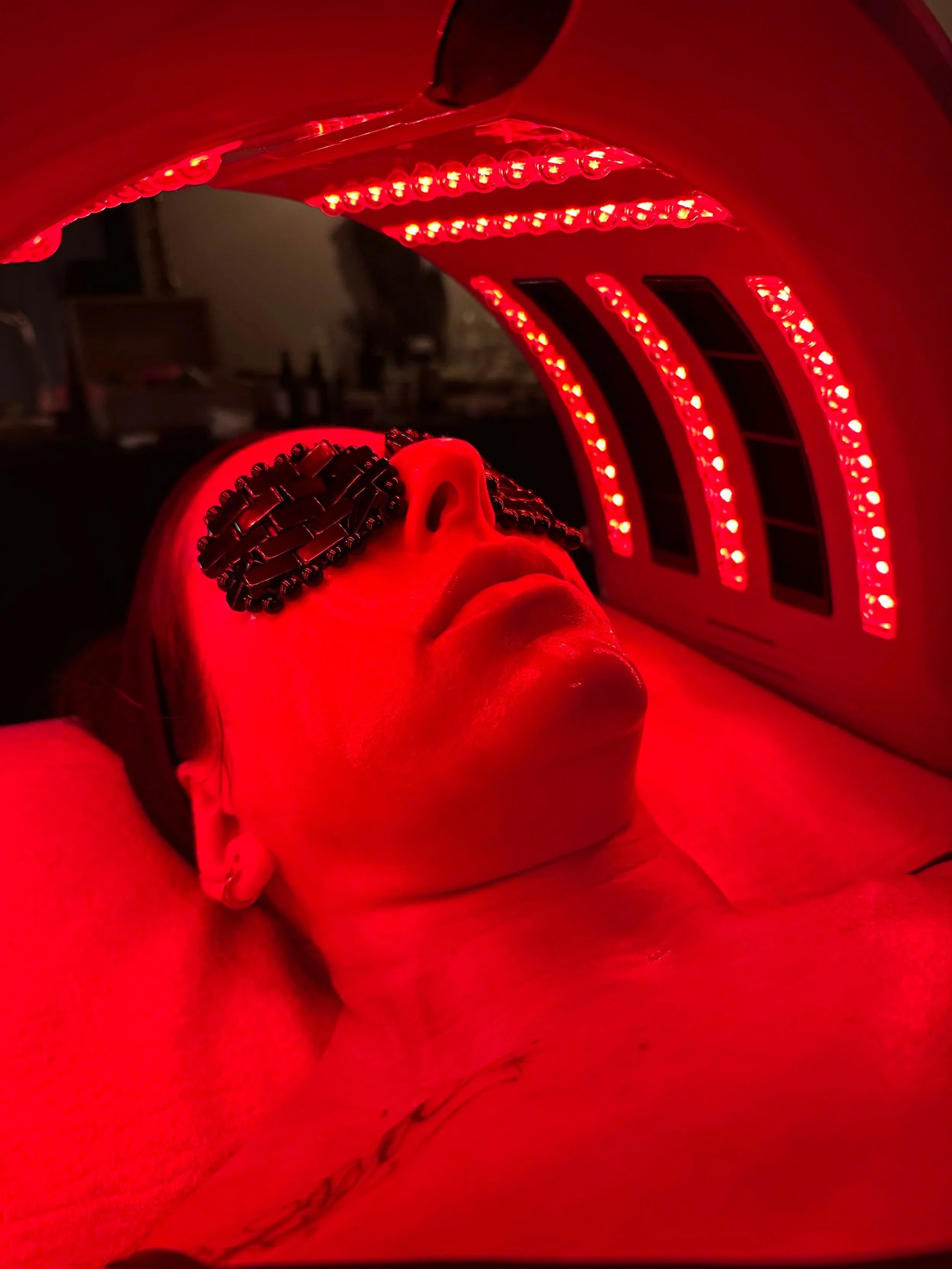
Red light therapy after micro needling
Red light in the 630–660 nm range is one of the most researched wavelengths in photobiomodulation (PBM). I use it for skin health, nervous system support, longevity, muscle and joint pain, and hair restoration.
Skin health
Red LEDs have been shown to:
Stimulate collagen production and reduce wrinkles by influencing fibroblasts and matrix metalloproteinases (MMPs). In one clinical study, red LED therapy improved wrinkle depth and skin roughness in over 90% of participants, with no downtime.
Improve overall skin texture and tone, including redness and mild scarring.
This is why I often pair red light with cosmetic acupuncture facials, micro-needling and facial gua work, which naturally affects the lymphatic system. it supports the same collagen pathways we are trying to nourish from the inside out.
Nervous system support
Red and near-infrared light both act on mitochondria (powerhouse of the cell), especially the enzyme cytochrome c oxidase, which can improve cellular energy and reduce oxidative stress. PBM to the head and body has been explored as a supportive therapy for mood, anxiety, and cognitive function, likely through increased blood flow, reduced inflammation, and improved neuronal metabolism. PMC+2ScienceDirect+2
I see amazing results when I add red light therapy to my treatments for patients with anxiety and depression. While I am not recommending it as a stand alone treatment for mental health disorders, I do see red light as one more gentle tool to help calm an overtaxed nervous system alongside acupuncture, breath work, yoga, and traditional talk therapy.
Muscle, joint & pain Relief
Red light, especially when combined with near-infrared, has been shown to:
Reduce delayed onset muscle soreness (DOMS)
Improve muscle performance and recovery when used before or after exercise PMC+2MDPI+2
In practice, I might place panels over the low back, knees, or shoulders while needles are doing their work, to support circulation, tissue repair, and pain modulation.
Hair restoration
Low-level red light (often around 655 nm) has been studied for androgenetic (pattern) hair loss. Randomized, sham-controlled trials have shown significant improvements in hair counts in both men and women using red light–based devices. SpringerLink+3PMC+3JCAD+3
For hair protocols, I pair red and NIR light with scalp acupuncture, micro-needling and topical/ internal herbal support to encourage follicles back into an active growth phase.
Green LED Light (≈ 520–540 nm): Pigment, redness & “cooling” the skin
Green light sits between blue and red in terms of penetration. It mostly affects the epidermis and upper dermis, where many pigment and vascular issues live.
Skin health
Clinical studies using green-spectrum lasers (typically around 532 nm) have shown:
Improvement in hyperpigmentation and melasma, particularly epidermal pigment, because green light is selectively absorbed by melanin and hemoglobin in more superficial layers. PMC+2AD Annals of Dermatology+2
While lasers and LEDs are different in power and delivery, we borrow wavelength lessons from this research. I use green LED to gently support:
Blotchiness and visible redness
Overall tone in combination with red light for rejuvenation
Nervous system & recovery
Green light doesn’t penetrate as deeply as red or NIR, so its primary role in my practice is soothing the skin, which indirectly soothes the nervous system. When the face feels less hot, reactive, or inflamed, we often see a softening in overall stress load, especially in sensitive, rosacea-prone, or “reactive” skin types.
Blue LED Light (≈ 415–450 nm): Clarifying, antibacterial surface support
Blue light has the shortest wavelength of the LEDs I use and stays very close to the skin surface.
Skin health
Blue LED (around 415 nm) is best known for acne:
It helps reduce Cutibacterium acnes (formerly Propionibacterium acnes) by exciting bacterial porphyrins that then generate reactive oxygen species, creating an antimicrobial effect without systemic antibiotics. MDPI+3PubMed+3OUP Academic+3
Randomized trials and systematic reviews show improvements in inflammatory acne lesions using blue or combined blue + red light regimens.
I layer blue LED into treatment plans for congested, breakout-prone skin, then follow with red light to support healing and reduce post-inflammatory marks.
Nervous system, muscle & hair
Blue light is not my primary tool for nervous system work, muscle recovery, joints, or hair growth, that is where red and near-infrared shine. However, clearing painful, inflamed skin (especially on the face) can have a profound emotional and nervous system impact, so it fits into the picture of whole-person care.
Near-Infrared (NIR) Light (≈ 800–900+ nm): Deep tissue, joints & brain
Near-infrared light is invisible to the eye but deeply felt by the body. Its longer wavelength allows it to reach muscles, joints, and even brain tissue in specific transcranial applications. JKS LMS+3PMC+3MDPI+3
Muscle recovery & joint health
NIR PBM has been shown to:
Reduce muscle fatigue and improve recovery when used before or after exercise Archives PMR+3PMC+3ScienceDirect+3
Help with joint pain and function in conditions like osteoarthritis in some clinical trials
In the clinic, I use NIR panels over knees, hips, shoulders, or the low back while acupuncture supports meridians and fascial lines. It’s a beautiful combination for:
Athletes or active adults recovering from training
Chronic joint or tendon pain
Post-injury recovery, when appropriate
Nervous system & brain health
Red and NIR light to the head (transcranial photobiomodulation) has growing evidence as a supportive therapy for:
Mood and anxiety disorders
Cognitive function and neurodegenerative conditions
Traumatic brain injury recovery
These effects are thought to come from improved cerebral blood flow, mitochondrial function, reduced inflammation, and enhanced neurogenesis. SAGE Journals+4PMC+4MDPI+4
I integrate this more gently in practice, using NIR near the head and neck while we work with acupuncture points to down-shift the nervous system into a rest-and-repair state.
Hair restoration
NIR (for example 808–830 nm) often appears in combination devices with red light for hair loss, and some data suggest that these deeper wavelengths further support hair density and scalp health. ISHRS+2Actas Dermo-Sifiliográficas+2
In my hair restoration protocols, NIR is part of a layered approach that includes:
Acupuncture and scalp microneedling (when indicated)
Light therapy at red and NIR wavelengths
Nutritional and hormonal support when appropriate
Why this matters in my practice
I didn’t add LED and near-infrared light therapy to chase a trend. I added them because:
They align with my existing philosophy: gentle, non-invasive, cumulative therapies that respect the body’s own healing intelligence.
There is a growing body of peer-reviewed research supporting their role in skin rejuvenation, acne, pigment, muscle recovery, joint pain, mood, and hair restoration. SAGE Journals+4Wiley Online Library+4Lippincott Journals+4
They layer beautifully with acupuncture, facial rejuvenation, movement, and breath, enhancing outcomes without adding more strain to the system.
In other words, light becomes another way to “needle” the body, without a needle, inviting cells, fascia, nerves, and follicles to remember how to heal.
If you are curious whether red, green, blue, or near-infrared light could be woven into your treatment plan, we can explore it together at your next visit.
